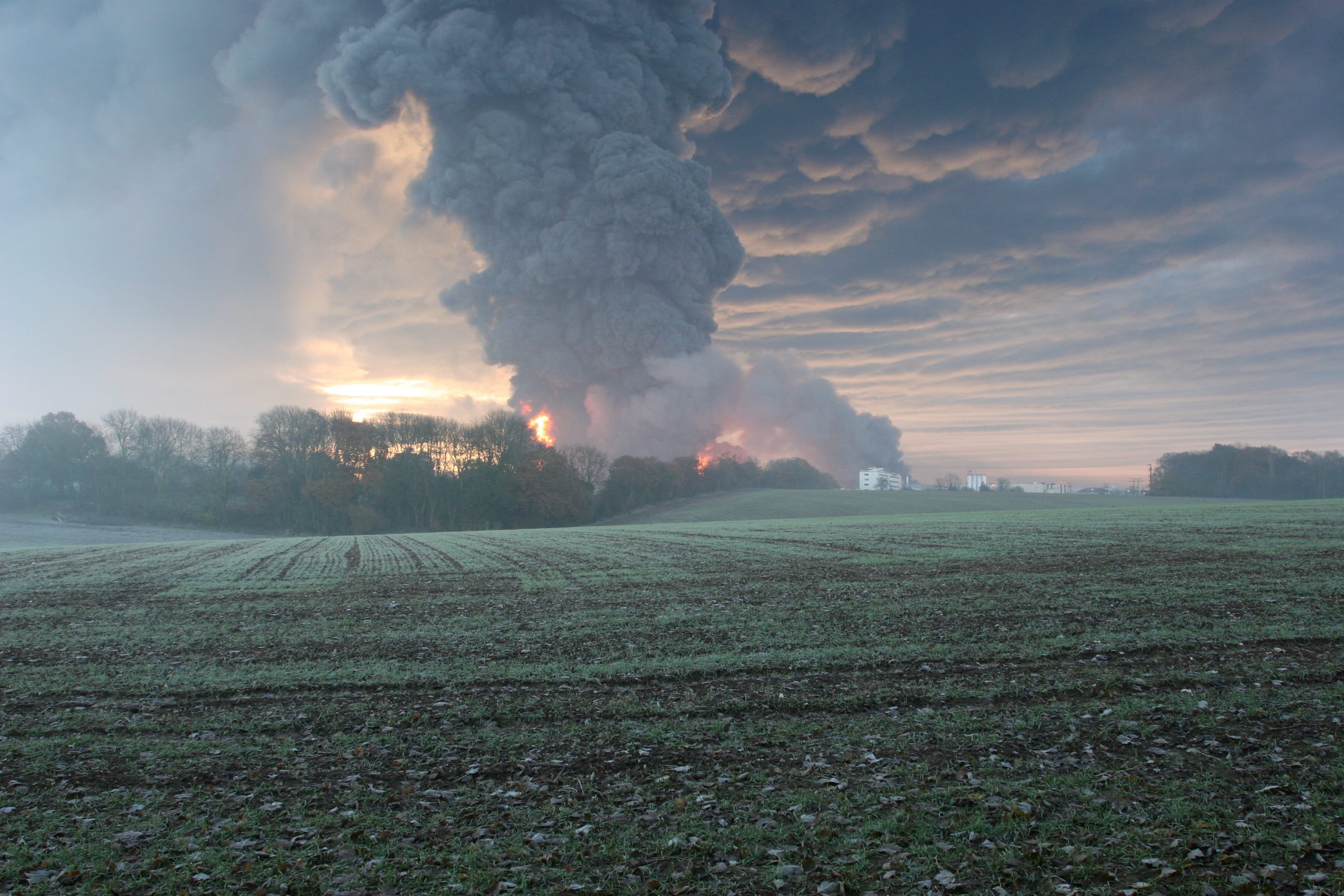
On the night of Saturday 10 December 2005, Tank 912 at the Buncefield oil storage depot in Hertfordshire was filling with petrol. The tank had two forms of level control: a gauge that enabled the employees to monitor the filling operation; and an independent high-level switch (IHLS) which was meant to stop operations automatically if the tank was over-filled.
The first gauge stuck and the IHLS was inoperable – there was therefore no means to alert the control room staff that the tank was filling to dangerous levels. Eventually, large quantities of petrol overflowed from the top of the tank. A vapour cloud formed which ignited, causing a massive explosion and a fire which burned for five days.
It was five years until the court case reached St Albans Crown Court, in July 2010. After convictions of five companies involved were handed down, Gordon MacDonald – then Director of the Hazardous Installations Directorate of the Health and Safety Executive (HSE) – stood on the steps outside the court and made a strong public statement.
He emphasised the five companies involved were “held to account publicly for the failings that led to the Buncefield explosions”. He also acknowledged the incident as “Britain's costliest petro-chemical accident” and stressed that while such explosions are rare, “they shouldn't happen at all”.
In his statement, MacDonald challenged the leaders of the UK’s high hazard industries to learn from their failings and to address three critical questions to prevent similar incidents:
- Do we understand what can go wrong?
- Do we know what systems are in place to prevent this happening?
- Do we have assurance that these systems will work?
His three questions were simple, yet they went to the heart of good process safety management and remain as relevant today as 20 years ago.
Cogent’s Role in Driving Change
In the aftermath of the Buncefield disaster, the UK Process Safety Management (PSM) Competence Programme Board was formed. This was in response to a call from the UK’s Health and Safety Executive for the industry to do more to avoid such accidents in the future.
The Board is a collaboration of industry leaders, duty holders, trade unions, industry associations, stakeholders and regulatory bodies who give their time on a voluntary basis. The board, which is supported by Cogent Skills’ exists to:
- Establish and maintain industry training and standards – providing ongoing direction to keep major accident hazard sites safe and responsibly manage their process risks
- Create leadership awareness about the importance of process safety management across the high hazard sector
- Encourage companies to take on process safety leadership training and cascade it through their organisation
Since its inception, more than 25,000 individuals have benefitted from process safety training aligned to the standards maintained by the Programme Board, helping to embed a culture of safety and competence across high-hazard industries.
As Dame Judith Hackitt, former Chair of HSE, said in 2012: “This training standard addresses an issue that was holding back companies from making progress with improving safety leadership on the ground.
“Having completed this training, senior executives will be competent to take a much more visible role in leading their organisation and will be better placed to take integrated consideration of major hazard risks as an essential part of key business decisions.”
Cogent Skills led the delivery of these courses and has overseen the quality of the programme – indeed it’s down to the efforts of Cogent staff that so many people have been trained at a range of levels in different areas. Over time the courses have evolved in full qualifications, further widening the staff and sites who can benefit from them as well and deepened the skills of those who undertake them.
The training standards framework, developed and maintained by the Board, is benchmarked to COMAH/SEVESO II requirements. It covers process safety management skills, knowledge, understanding and culture, and is relevant to all industries with process safety risks – those with the potential for catastrophic incidents to people, property and the environment.
Over the last two decades, many advances have been made in keeping sites, staff and the environment safe across high-hazard sites. Lessons were learned from Buncefield, but the increased vigilance and cultural shift the incident brought about must continue to guide these industries in the future.